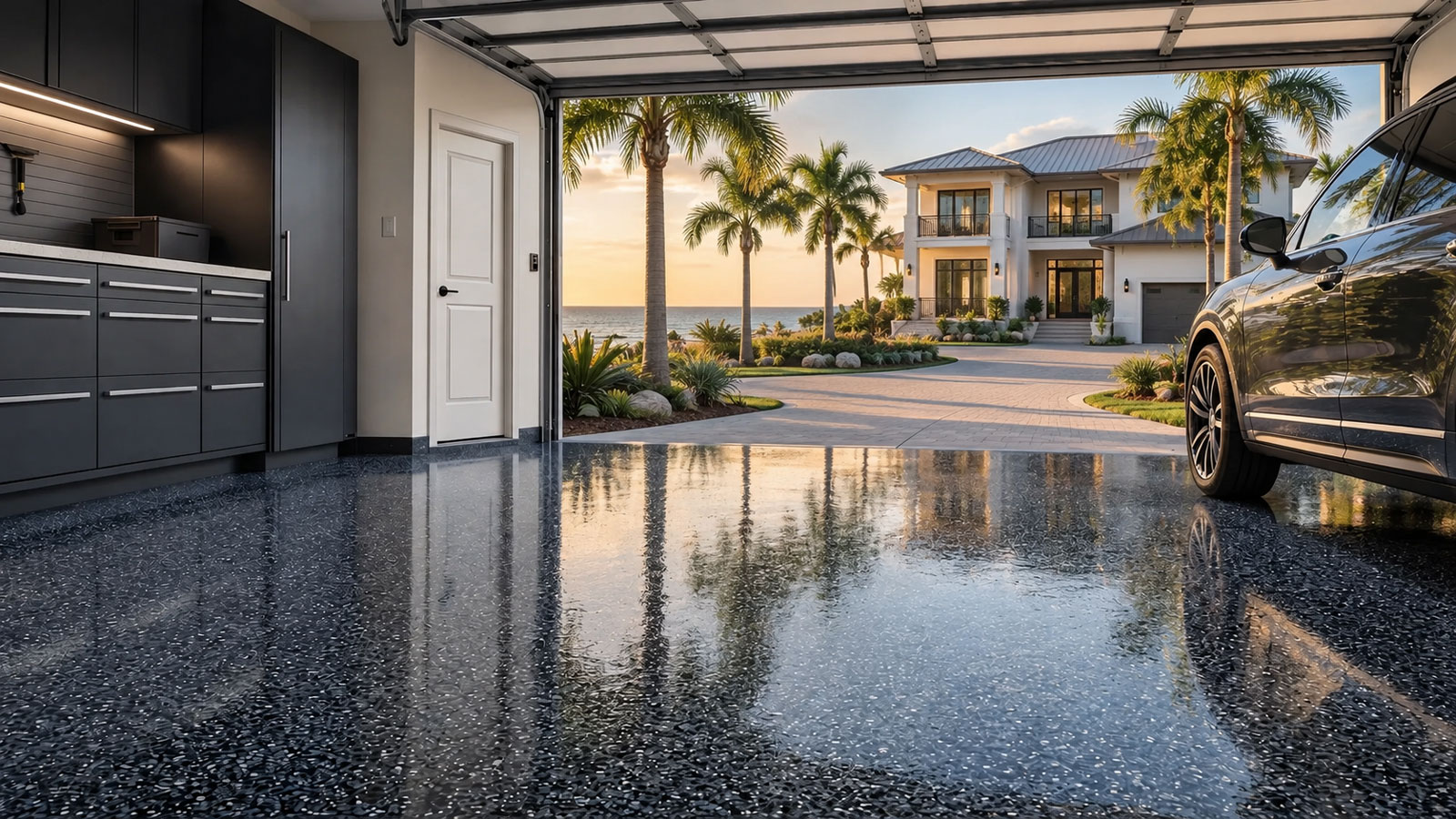
Garage Floor Coating in Wellington, FL
Floor Coating Considerations in Wellington, FL
The local drainage context around Wellington deserves a more specific explanation than a generic South Florida humidity claim. Acme Improvement District maintains more than 2,000 catch basins and nine pump stations. This official public-works or utility fact can help residents understand where runoff is managed but does not test the concrete in a private garage. Whether a coating will adhere depends on the existing slab and how it is prepared, not on an infrastructure count or neighborhood label.
A second documentary point is that its drainage system includes 91 miles of canals and about 270 acres of detention lakes. In addition, Wellington swales normally pond runoff for 24–36 hours and the village reconditions three to four miles yearly. Together these describe public drainage and maintenance choices that differ from nearby communities. A homeowner should observe whether water crosses the garage threshold, collects only beneath wet tires or remains within concrete after the surface otherwise dries. Those situations are distinct; the coating itself cannot correct an exterior drainage problem.
For equestrian-area properties, agricultural-adjacent storage and ordinary residential garages, the floor may have old paint, prior patches, oil residue, cracks or a different construction date from the house. Ask about mechanical grinding, removal of weak finishes, sound repairs and movement-joint treatment. Strong sun at a garage entry, vehicle tires and the household's use schedule also affect the actual epoxy or polyaspartic assembly. The right quote describes the layers and cure window rather than assuming a citywide flood condition.
Local Market Insight
Acme Improvement District and Village of Wellington: Acme Improvement District maintains more than 2,000 catch basins and nine pump stations; its drainage system includes 91 miles of canals and about 270 acres of detention lakes. These are municipal or public district facts, not findings of moisture or coating readiness for any particular garage; examine the concrete and doorway independently.
What Affects the Cost of Garage Floor Coating in Wellington?
The local pricing considerations in Wellington begin with Acme Improvement District and Village of Wellington's responsibility compared with the private floor. Acme Improvement District maintains more than 2,000 catch basins and nine pump stations. That does not imply automatic work or a moisture surcharge at a residence.
These are municipal or public district facts, not findings of moisture or coating readiness for any particular garage; examine the concrete and doorway independently. This is useful when defining the scope of a Wellington garage estimate, not a basis for a citywide price premium. The published $6–$12 per-square-foot and $3,000–$5,500 typical two-car ranges are planning references only. Ask the bidder to itemize removal, grinding, any repairs and the full coating system before treating a quote as comparable.
Garage floor coating cost depends on the floor itself as well as square footage. A project review should account for slab condition, crack repair, moisture mitigation, surface preparation, coating system, decorative flake or finish, access, and scope.
- Public infrastructure setting: Acme Improvement District maintains more than 2,000 catch basins and nine pump stations. This is a documented local system or program; an installer must still inspect actual slab condition and the garage-door water path.
- Recorded utility and asset detail: its drainage system includes 91 miles of canals and about 270 acres of detention lakes. A system serving multiple neighborhoods does not establish a particular garage's vapor emission or paint adhesion.
- Additional drainage consideration: Wellington swales normally pond runoff for 24–36 hours and the village reconditions three to four miles yearly. Ask which public body, association or property owner handles real runoff problems before including exterior work in a coating proposal.
- Existing paint, repairs and oil: For equestrian-area properties, agricultural-adjacent storage and ordinary residential garages, concrete preparation needs a direct check for old sealer, paint, oil, patch compounds and the profile specified by the selected resin system.
- Cracks, joints and access: The quote should distinguish stable crack repair from moving control joints and include threshold edges, steps and preparation around stored items.
- Finish, UV and vehicle timing: Evaluate the full primer/body/topcoat assembly for sun at the entrance, hot-tire use, traction, cleaning and realistic cure limitations.
Call for a clear, project-specific estimate—or request one online.
What Wellington's Drainage Documents Do—and Do Not—Show
Acme Improvement District maintains more than 2,000 catch basins and nine pump stations. This is specific public information from Acme Improvement District and Village of Wellington and it helps differentiate the community from neighboring towns. It does not indicate that every home requires a moisture mitigation layer or that a particular garage has experienced flooding.
its drainage system includes 91 miles of canals and about 270 acres of detention lakes. The public drainage system manages water over many parcels, while an individual garage is affected by its actual driveway grading, apron and door seal. Owners should observe where rainwater goes during and after storms and separate ordinary tire-tracked water from persistent runoff into the garage.
Wellington swales normally pond runoff for 24–36 hours and the village reconditions three to four miles yearly. This additional fact provides useful context for maintenance and responsibilities, yet it does not substitute for an address-specific inspection. A private garage can need drainage attention even where public assets are well maintained, or have a sound slab in a region with complicated waterways.
Acme Improvement District maintains more than 2,000 catch basins and nine pump stations. For a Wellington floor project, this distinction requires inspecting the actual garage doorway after rainfall rather than assuming public drainage predicts indoor conditions. Water carried in by tires, flow crossing a driveway lip and concrete that remains damp have different causes. Document them before any moisture-related product is proposed, and keep exterior drainage corrections separate from the finish.
Wellington Garage Preparation, Access and Return-to-Use
For equestrian-area properties, agricultural-adjacent storage and ordinary residential garages, construction and remodeling histories may be quite different from a neighboring house. The garage slab may have been patched or resurfaced after original construction; previous floor paint and oils can change grinding work even when the floor appears clean. A generic coating quote must not assume all concrete is equally ready for resin.
Whether a coating will adhere depends on the existing slab and how it is prepared, not on an infrastructure count or neighborhood label. The corresponding garage inspection should identify old paint and sealers, contaminated areas, patch compounds and the profile of sound concrete. Stable repairs and movement joints must be handled differently. Ask which areas near steps, shelving and edges are included in preparation and what happens if grinding exposes a weak prior finish.
In addition, Wellington swales normally pond runoff for 24–36 hours and the village reconditions three to four miles yearly. For a Wellington floor project, this distinction requires inspecting the actual garage doorway after rainfall rather than assuming public drainage predicts indoor conditions. Water carried in by tires, flow crossing a driveway lip and concrete that remains damp have different causes. Document them before any moisture-related product is proposed, and keep exterior drainage corrections separate from the finish.
A homeowner should observe whether water crosses the garage threshold, collects only beneath wet tires or remains within concrete after the surface otherwise dries. For a garage in Wellington, the relevant choice is the system specified for the existing slab, not the area's name. Discuss contamination and prior repairs first, then UV at the door, traction for wet shoes, cleaning habits and the manufacturer's application and vehicle-return limits. A decorative resin finish cannot compensate for unsupported concrete or for water entering from outside.
Frequently Asked Questions
What is distinctive about stormwater management in Wellington?
Acme Improvement District maintains more than 2,000 catch basins and nine pump stations. This describes public infrastructure or planning, not whether a private concrete garage needs a particular resin product.
What other local drainage figure or rule should I consider?
its drainage system includes 91 miles of canals and about 270 acres of detention lakes. Individual thresholds and slab conditions need their own inspection despite municipal or district drainage programs.
Can a coating solve runoff that comes in under the garage door?
No. Wellington swales normally pond runoff for 24–36 hours and the village reconditions three to four miles yearly. Real exterior entry should be addressed through appropriate drainage or grading, separately from floor coating.
Does a previously painted Wellington garage need grinding?
For equestrian-area properties, agricultural-adjacent storage and ordinary residential garages, the floor may have old paint, prior patches, oil residue, cracks or a different construction date from the house. For a garage in Wellington, the relevant choice is the system specified for the existing slab, not the area's name. Discuss contamination and prior repairs first, then UV at the door, traction for wet shoes, cleaning habits and the manufacturer's application and vehicle-return limits. A decorative resin finish cannot compensate for unsupported concrete or for water entering from outside.
Which details should my Wellington coating estimate include?
Old-finish removal, grinding, stable repairs, moving joints, edges, exact resin layers, traction and sunlight ratings and the times before walking and parking.
Wellington Neighborhoods & Local Context
Typical Project Cost
$3,000–$5,500
Typical two-car garage range. Final pricing depends on floor size, concrete condition, preparation, coating type, finish, and access.
Helpful Guides